How to Survive the First Week of School as a Health Science Teacher
Surviving the First Week Back-to-School
TIPS FOR TEACHERSNEW HEALTH SCIENCE TEACHER TIPS & TOOLSBACK TO SCHOOL


Nobody tells you this when you start teaching health science, but the first week is its own entirely separate skill set.
It's not about content. It's not about skills labs or certification prep or pacing guides. The first week is about one thing: convincing a room full of teenagers who don't know each other, aren't sure what this class is actually about, and definitely aren't sure about you yet, that this is a place worth showing up for.
If you nail that, everything else gets easier. If you skip it and dive straight into content because you're anxious about covering everything, you'll spend the rest of the semester fighting for engagement you never actually established.
Here's how to handle the first week in a way that sets you and your students up for a genuinely good year.
Day One Is Not About Content
Repeat after me. Day one is not about content.
Your syllabus can wait until day two. The introduction to health careers can wait until day three. What cannot wait is the moment when a student who walked into your room not knowing anyone walks out feeling like they belong there.
Health science is a field built on trust and communication. The students who become excellent healthcare professionals are the ones who learned early on how to connect with people they've just met, how to make someone feel comfortable in an uncomfortable situation, and how to be present with another person rather than just completing a task near them.
Your first day is your first opportunity to model all of that. Use it.
Do an Icebreaker That Actually Works
The word icebreaker makes some teachers cringe and honestly some students too. Because most icebreakers are terrible. "Tell us your name and one fun fact" is not an icebreaker. It's a slightly interactive roll call that everyone wants to be over.
A real icebreaker gets students out of their seats, talking to each other in low-stakes ways, and laughing a little. It surfaces things they have in common that they wouldn't have found out otherwise. It starts building the kind of classroom community that makes group work and clinical skills practice actually function later in the year.
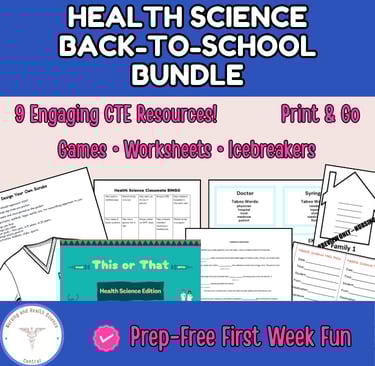
For health science specifically, icebreakers work best when they have some connection to the field even if it's loose. Classmate BINGO where students have to find someone who has done specific things related to health and careers is a great option because it gets everyone moving and talking without anyone feeling put on the spot. This or That with health science themed questions gets students on their feet and expressing opinions which immediately generates conversation. Design Your Own Scrubs lets students be creative and share something personal while also planting the idea that they are healthcare professionals in training.
These aren't time wasters. They're relationship builders and the relationships students build in your classroom in week one are the ones that will make them willing to practice skills on each other in week six.
Establish Your Expectations Through Experience, Not Lecture
Reading your syllabus out loud is one of the least effective ways to communicate your expectations. Students are not listening. They're reading ahead, wondering what they're having for lunch, or checking to see if your class looks like it's going to be worth their time.
Instead set your expectations through how you run the first few days. If you want students to come in and start working immediately, have something for them to do the moment they walk in. If you want them to treat each other with professionalism, model and require it from day one. If your lab has safety rules that are non-negotiable, introduce them through an activity that makes the consequences of ignoring them real and memorable rather than just listing them on a PowerPoint.
This approach is more work upfront but it pays off for 35 more weeks because students learn your expectations by experiencing them, not by being told about them once.
Let Them See Where This Is Going
One of the most motivating things you can do in the first week is let students see what the end looks like.
If your students are working toward PCT certification, show them what that certification exam covers and what kind of jobs it opens up. If you have former students who are now working in healthcare, see if one of them can come in for five minutes or record a quick video. If your program has clinical partners, name them. Tell students where they'll go and what they'll do there.
When students can see the endpoint, the journey makes more sense. And the journey includes all the content and skills practice and studying you're about to ask them to do. That's a lot easier to commit to when they understand why.
Don't Try to Cover Too Much
This is the one first-week mistake that even experienced health science teachers make. The anxiety about fitting everything into the year kicks in on day one and suddenly you're trying to introduce content when you should still be building community.
Your first week job is to do four things. Establish who you are and how this classroom runs. Help students get to know each other well enough to function as a learning community. Generate some excitement about the year ahead. And get the administrative necessities handled like syllabus distribution, contact information collection, and any required first-day paperwork.
Content starts in week two. And it goes better in week two because of what you did in week one.
The first week of school sets a tone that carries all the way to May. Teachers who invest in community, relationships, and excitement in those first five days spend the rest of the year reaping the benefits. Teachers who rush to content before the foundation is solid spend the rest of the year struggling to get students to engage with it.
Get a Stress-Free Head Start
If you want nine ready-to-use resources that handle your entire first week without any planning on your part, our Back to School Bundle has everything from icebreakers and community builders to vocabulary games and movement activities. Just print what you need and show up.
Want more free tools and tips for health science CTE teachers? Join our email community and get the free Back-to-School Health Science Teacher's Preparation Checklist the moment you sign up.