The Best Icebreakers for Health Science
The Best Icebreakers for Health Science That Actually Build Community
NEW HEALTH SCIENCE TEACHER TIPS & TOOLSTIPS FOR TEACHERSBACK TO SCHOOL


Here's the thing about icebreakers that nobody says out loud.
Most of them don't actually break any ice. They just make everyone sit through a slightly uncomfortable five minutes before the class moves on and students go back to not knowing each other. "Say your name and your favorite movie" doesn't build community. It builds a list of movies nobody asked for.
A real icebreaker changes something. Students walk in not knowing each other and walk out knowing at least a few names, having laughed at least once, and feeling like this class might actually be a place they want to be. That shift is what makes the rest of the year work.
For health science specifically, good icebreakers do something extra. They set a tone of professionalism, connection, and active participation that mirrors what healthcare actually looks like. In healthcare you have to communicate with strangers, make people feel comfortable quickly, and work as a team with people you didn't choose. The classroom is where students start practicing all of that, and it starts on day one.
Here are the formats that actually work and why.
Movement-Based Icebreakers Win Every Time
If a student has to physically get out of their seat and interact with another student, the icebreaker is already working better than most.
Movement-based icebreakers work for a few reasons. They break the physical inertia of sitting in a new classroom feeling awkward. They create multiple brief interactions instead of one long one, which is much less intimidating. And they generate energy in the room that you can channel into the lesson that follows.
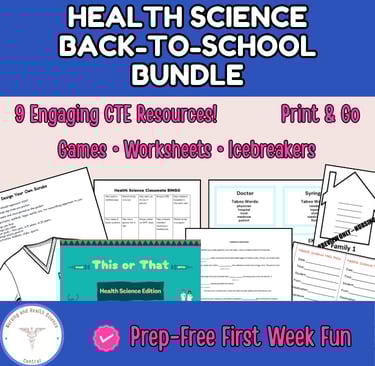
This or That is one of the simplest and most effective formats for health science classes. Put up a slide with two options and have students move to one side of the room or the other based on their answer. Health science themed questions get students thinking about the field while also expressing opinions and seeing who they agree with. Twelve questions takes about fifteen minutes and by the end of it students have interacted with everyone in the room at least once.
The key is to use questions that are genuinely interesting and a little bit revealing. "Stethoscope or blood pressure cuff" is fine. "Would you rather tell a patient bad news or be the one to help them feel better afterward" is better. Questions that touch on the real emotional and ethical dimensions of healthcare give students something to actually talk about.
Icebreakers That Create a Reason to Remember Names
The practical goal of any first-day icebreaker is that students leave knowing more names than they came in with. That sounds basic but it's the foundation of everything that follows. Students who know each other's names are more likely to ask each other for help, more willing to be practice partners, and more invested in the classroom as a community rather than just a place they happen to be.
Classmate BINGO is purpose-built for this. Students circulate around the room with a BINGO card that has prompts in each square, things like "has worked in a healthcare setting" or "plans to be a nurse" or "has a family member who works in healthcare." To fill a square they have to find a classmate who matches and write down that person's name.
The genius of this format is that students are motivated by the game to approach people they might not have chosen to talk to otherwise. And because they're writing down names, they actually remember them. By the time the activity is over students have had five to ten brief but meaningful conversations and know more names than they would have learned in a week of regular class.
Creative Icebreakers That Reveal Personality
Some of your best icebreakers are ones that let students express something about themselves in a low-stakes way that doesn't feel like a performance.
Design Your Own Scrubs does this beautifully. Students get a scrub template and personalize it with symbols, colors, words, or designs that represent who they are and what they want to bring to their healthcare career. Then they share their scrubs through a gallery walk or partner conversation.
What this activity does that purely conversational icebreakers don't is give students something to look at and react to rather than just respond to a question cold. It's much easier to walk up to someone's scrub design and say "I love that you put a stethoscope here, do you want to be a nurse?" than to walk up to a stranger and just introduce yourself.
It also sets up something you can return to all year. Posting the scrubs in your classroom creates a visual reminder that these students are healthcare professionals in training. That identity framing matters more than most teachers realize.
What to Avoid
A few icebreaker formats that don't work well in health science classrooms specifically.
Anything that requires students to share something personal in front of the whole group without choosing to. Some students will do it fine. Others will be so focused on dreading their turn that they don't absorb anything else that happens in class that day.
Anything competitive that creates obvious winners and losers on the first day. Health science requires collaboration and trust. Starting with competition before trust exists works against you.
And anything that goes on so long students start checking out. Icebreakers should leave students wanting a little more, not relieved that it's finally over. Twenty minutes is generally your maximum. Fifteen is better.
Build On the Connections You Create
The icebreaker isn't the goal. The relationships it starts are the goal.
After your first-day activities, make intentional choices that build on those early connections. Seat students near people they met during the icebreaker. Use the same small groups for the first few weeks so students can develop working relationships before you mix things up. Reference things you learned about students during the icebreaker in later conversations so they know you were paying attention.
Community in a classroom doesn't happen in one activity. It happens in the accumulation of small moments where students feel seen and connected. The icebreaker is just the first one.
The right icebreaker on the right day can change the entire trajectory of a class. It's worth putting as much thought into as any lesson you'll teach all year.
If you want all of these activities ready to print and use tomorrow, the Back to School Bundle includes Classmate BINGO, This or That, and Design Your Own Scrubs plus six more resources that work for the first week and beyond.
Want more free tools and tips for health science CTE teachers? Join our email community and get the free Back-to-School Health Science Teacher's Preparation Checklist the moment you sign up.