How to Set Up Your Health Science Classroom & Skills Lab Before School Starts
Tips for Nursing & Health Science Classroom & Lab Setup
NEW HEALTH SCIENCE TEACHERSTIPS FOR TEACHERSBACK TO SCHOOL


There's a specific kind of dread that hits health science teachers in late July.
You know the one. You're sitting on your couch, maybe halfway through a book you've been trying to read since June, and suddenly your brain goes, "Wait. Did I order more lancets? Are the mannequins still clean? Did someone borrow the pulse oximeters at the end of last year and never bring them back?"
And just like that, summer is over in your head even if it's not over on the calendar.
Setting up a health science skills lab is genuinely different from setting up a regular classroom. You're not just arranging desks and hanging posters. You're managing medical equipment, infection control supplies, clinical paperwork, and in many cases the logistics of getting students off campus to partner sites. There are a lot of moving parts, and the teachers who walk into August feeling calm and ready are the ones who dealt with those parts before the chaos started.
Here's how to do that without spending your entire summer on it.
Start With Your Equipment Inventory
Before you order anything, buy anything, or panic about anything, do a full equipment inventory. Pull everything out, check that it works, and make a list of what's missing, broken, expired, or just plain gone.
For most health science skills labs this means going through your vital signs equipment, including blood pressure cuffs in multiple sizes, stethoscopes, thermometers, pulse oximeters, and anything else students use regularly. Check your phlebotomy supplies if you teach that pathway, including practice arms, tubes, needles, tourniquets, and sharps containers. Check your EKG equipment if applicable, including leads, electrodes, and machine functionality. Check your patient care supplies, including transfer belts, bed linens, positioning equipment, and anything used for personal care skills practice.
While you're at it, check expiration dates on anything that has them. Gloves, alcohol prep pads, gauze, lancets, and similar consumables all expire and using expired supplies in student skills practice is both ineffective and a bad habit to model.
Make two lists as you go. One for things you need to replace or restock, and one for things that need to be repaired, sanitized, or organized. The first list becomes your purchase order. The second list becomes your weekend project.
Get Your Purchase Orders In Early
This is the one health science teachers learn the hard way, usually after waiting too long and watching school start without the supplies they needed.
Most schools have a purchase order process with deadlines, approval chains, and lead times that are longer than you'd expect. If you submit your supply request the week before school starts, there's a real chance your gloves and electrode pads don't arrive until October. Submit in July and you're almost always covered.
Know your school's process before you need it. Who approves purchase orders in your department? How long does approval typically take? Does your district have preferred vendors or does everything have to go through a specific system? If you don't know the answers to those questions, the first week of your prep should include finding out.
While you're at it, check whether any of your supplies can be requested through your clinical partners. Some hospital partners will donate expired-but-usable supplies to CTE programs, which is a great way to stretch a budget that was probably already tight before you started.
Sanitize Everything Before Students Touch It
This one sounds obvious but it's easy to skip when you're rushing to get other things done. Mannequins, reusable equipment, simulation arms, and anything else that students handle repeatedly needs to be cleaned before a new group of students starts using it.
This is especially true for anything used for personal care skills practice like washbasins, bed rails, and positioning equipment. It's also true for stethoscopes and blood pressure cuffs that get passed from student to student throughout a class period.
Set aside a few hours specifically for sanitizing before school starts. It's not glamorous work but it matters for two reasons. First because it models the infection control practices you'll be teaching your students all year. And second because clinical partners pay attention to whether your classroom environment reflects real healthcare standards. Walking into a lab that smells clean and looks organized tells them something about your program.
Organize Your Storage So Students Can Function Independently
Here's something that pays dividends all year long. If students can't find what they need without asking you, you'll spend half of every skills lab answering the same questions instead of actually teaching.
Label everything. Bins, drawers, shelves, supply stations. Use clear labels with both the item name and a visual if you can, especially for students who are still learning the names of equipment. Organize by skill or by certification pathway depending on how your lab is structured.
Think about traffic flow too. Where will students gather when they're waiting to practice a skill? Where will they go to get supplies? Where will they dispose of used materials? If those answers aren't obvious from looking at your lab layout, students will create their own answers and they won't always be the ones you wanted.
Sort Out Your Clinical Site Logistics
If your program includes clinical rotations, back to school prep isn't just about your classroom. It's also about your partner sites.
Before school starts, confirm that your clinical affiliation agreements are current and signed for every site you plan to use. These agreements expire and renewal doesn't always happen automatically. If an agreement lapsed over the summer and you find out on the first day a student is supposed to be placed, you're in a very uncomfortable position.
Contact your clinical supervisors directly, not just through email, to confirm schedules, rotation dates, and any changes in student requirements. Sites sometimes update their dress code policies, immunization requirements, or check-in procedures over the summer without thinking to notify you. A quick phone call before school starts catches those changes before they become problems on day one of rotations.
Also confirm transportation logistics if your school provides it. That's the kind of thing that falls through the cracks during summer and shows up as a surprise in week two when students are supposed to be somewhere and there's no vehicle available.
Set Up Your Classroom for Day One
With the skills lab sorted, shift your attention to the front-of-house classroom space. Get your seating arranged, your bulletin boards updated, your technology tested, and your first week materials ready to go before the students arrive.
This sounds obvious but the skills lab prep often takes longer than expected and teachers end up scrambling to set up the regular classroom the night before school starts. Give yourself time for both.
Have your bell ringer for day one ready to project the moment students walk in. Have your syllabus printed or uploaded. Have your first day activity in hand. When everything is ready before you arrive, you can actually be present for your students instead of mentally running through your to-do list while they're sitting in front of you.
Grab Your Prep Resources
Setting up a health science skills lab well takes time but it's the kind of time that pays off every single week of the school year. A well-organized, fully stocked, properly sanitized lab makes your teaching easier, your students more independent, and your program more credible to the clinical partners who are watching.
If you want a complete pre-school checklist that covers your classroom, your skills lab, your clinical sites, your compliance requirements, and even your own personal prep, grab the free Health Science CTE Teacher Back to School Checklist. It covers everything we talked about here and then some, organized section by section so you can work through it without missing a thing.
Better yet - check out our CTE Health Science Teacher Planner. It is a complete, print-and-customize planning system designed specifically for health science teachers. And it's undated - buy it once, print what you need, and use it every August for as long as you teach health science.
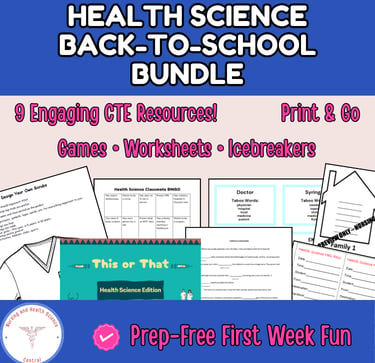
And if you're still pulling together your first week student activities, our Back to School Bundle has nine ready-to-use resources that handle your entire first week in one download.


CONTACT Us
info@nursinghealthscience.com
© 2026. Nursing & Health Science Central. All rights reserved.