How to Keep Health Science Students Engaged All Year With Bell Ringers
Health Science Bell Ringers
NEW HEALTH SCIENCE TEACHER TIPS & TOOLSTIPS FOR TEACHERS


There is a moment at the beginning of every class period that either belongs to you or it doesn't.
Students walk in. Some of them are still half asleep. Some of them are arguing about something that happened in the hallway. Some of them are on their phones doing something they'll put away the second you look at them. All of them are technically in the room but none of them are actually present yet.
What happens in the next three to five minutes determines whether you get them back or spend the first chunk of class fighting for attention you should already have.
Bell ringers solve this problem. Not the boring kind where students copy a definition off the board and wait for you to go over it. The kind that actually make students think, connect content to something real, and ease them into the lesson before they even realize they're working.
For health science specifically, bell ringers do something extra. They reinforce the kind of clinical reasoning and medical vocabulary that students need to internalize long before they walk into a patient room. Every single prompt is an opportunity to build the habit of thinking like a healthcare professional.
Here's how to do them well all year long.
Why Bell Ringers Work in a Health Science Classroom
The research on bell ringers isn't subtle. When students have a structured task waiting for them the moment they walk through the door, transition time drops, behavior problems during the first five minutes of class decrease, and students actually remember more content at the end of the unit because they've encountered the same ideas in multiple low-stakes contexts over time.
For health science students specifically, there's an additional benefit. Bell ringers create repetition in a context where repetition is critical. You can teach the order of draw once and most students will understand it. Teach it again in a bell ringer two weeks later and more students will remember it. Reference it again in a scenario prompt in March and by the time certification testing rolls around it's automatic.
That's the kind of retention that matters on an exam and on a clinical floor.
What Makes a Good Health Science Bell Ringer
Not all bell ringers are created equal. A vocabulary definition is fine. A scenario that asks students to apply what they know is better.
The best health science bell ringers do one or more of these things. They connect content to a real clinical situation so students can see why it matters. They ask students to recall something they learned previously rather than just process new information. They require brief written responses rather than yes or no answers so you can quickly scan for misconceptions. And they take no more than five minutes so you don't eat into your instructional time.
Some of the most effective formats for health science bell ringers include patient scenarios where students identify what's wrong or what should happen next, normal versus abnormal identification where students look at a set of values and determine which require follow-up, vocabulary in context where a term appears in a sentence and students explain what it means or describe how it applies, and quick ethical dilemmas where students write two sentences about what they would do and why.
What doesn't work as well is anything that requires students to look something up, wait for you to give them information, or complete a task they've never encountered before. Bell ringers should feel familiar enough that students can start immediately without needing instructions.
How to Structure Bell Ringers Into Your Routine
The key word is routine. Bell ringers only work if they're consistent. If students know that a prompt will be on the board every single day when they walk in, they'll sit down and start. If it only happens sometimes, they'll wait to see whether today is a bell ringer day before they settle in.
Project your bell ringer before the first student walks in. Have a designated spot on your board or screen where it always appears so students aren't scanning the room trying to figure out where to look. Give students three to four minutes to complete it independently. Then spend one to two minutes going over it as a class, not to grade it but to surface misconceptions and connect it to what you're doing that day.
That whole sequence takes five minutes max. Five minutes that pay you back in attention, retention, and a class that's already thinking about health science by the time you start your lesson.
Keep Them Seasonal Without Losing Instructional Value
One of the things health science teachers struggle with is keeping bell ringers fresh across a 36-week school year. The content you're covering changes, the semester shifts, and a bell ringer about vital signs in August can start to feel repetitive by November if you're not mixing it up.
Seasonal and holiday themes are a great way to keep prompts feeling fresh without sacrificing instructional value. A Halloween prompt about communicable diseases. A Thanksgiving prompt about nutrition and therapeutic diets. A winter prompt about hypothermia and frostbite. A Valentine's Day prompt about cardiac anatomy.
When you connect health science content to things students are already thinking about in the outside world, engagement goes up. And students often remember the content better because it was anchored to something memorable.
The trick is making sure the seasonal element is the vehicle, not the destination. The prompt isn't about Halloween. It's about disease transmission and Halloween just makes it more interesting.
Plan Ahead So You're Not Writing Prompts on Sunday Night
Here's where the good intention of daily bell ringers often breaks down. Teachers commit to doing them, do them consistently for the first few weeks, and then hit a stretch where planning got away from them and suddenly it's Sunday night and they need five prompts for next week and they have nothing.
The solution is to batch your bell ringers at the beginning of each unit rather than writing them week by week. When you're planning a unit on infection control, write eight to ten bell ringers for that unit at the same time you're planning the other lessons. Then you have a bank to pull from and the Sunday night scramble disappears.
Even better, build your bank at the beginning of the year. If you have 150 prompts in hand before school starts, covering all your major content areas with seasonal themes woven in, you're set. You just open the bank, pick the prompt that fits the day, and project it.
Bell ringers are one of those investments that pay for themselves over and over again. Five minutes a day, every day, adds up to dozens of extra hours of reinforcement by the end of the year, and that's the difference between students who kind of remember something and students who actually know it when it counts.
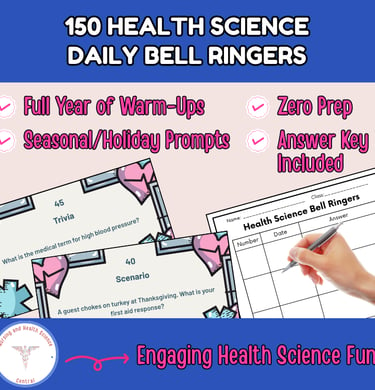
If you want 150 health science bell ringers already written, organized, and ready to project, our 150 Health Science Bell Ringers pack has a full year of daily prompts with an answer key and seasonal themes built in. You never have to write one from scratch.
Want more free tools and tips for health science CTE teachers? Join our email community and get the free Back-to-School Health Science Teacher's Preparation Checklist the moment you sign up.