
What I Wish I Knew Before My First Year Teaching High School Health Science
Words of Wisdom for New Nursing & High School CTE Health Science Teachers
TIPS FOR TEACHERSBACK TO SCHOOLNEW HEALTH SCIENCE TEACHERS


So you spent years in healthcare and now you're stepping into a classroom full of teenagers in August.
First, congratulations. Health science CTE programs need experienced clinicians who can bring real-world knowledge into the classroom, and your students are genuinely lucky to have someone who has actually done the work they're preparing for.
Second, a gentle warning. Being excellent at healthcare and being excellent at teaching healthcare are two different skill sets. Knowing the content is necessary but not sufficient. The classroom has its own logic, its own rhythms, and its own set of challenges that have nothing to do with your clinical knowledge and everything to do with skills you haven't had to use before.
That's not a reason to panic. It's a reason to prepare. And the nurses and clinicians who make the most successful transitions to teaching are almost always the ones who went in with realistic expectations and a willingness to learn the teaching side of the job the same way they once learned the clinical side.
Here's what most first-year health science teachers wish they had known before August.
Your Clinical Knowledge Is an Asset but It's Not Enough
You know more about actual patient care than almost any other health science teacher your students will ever have. That's genuinely valuable and your students will respond to it. Real stories from clinical experience, specific examples of what things look like in actual healthcare settings, the ability to answer "but why does that matter" with a real answer instead of "because it's on the test." These are things experienced clinicians bring to the classroom that curriculum alone cannot replicate.
But clinical knowledge doesn't automatically translate into teaching skill. Teaching requires you to explain things at a beginner level when your own understanding is expert-level, which is harder than it sounds. It requires you to manage a room full of people who did not choose to be there the way your patients chose to seek care. It requires you to assess learning, not just performance, and to find ways to reach students who aren't getting it without losing the students who are.
You'll figure all of this out. But go in knowing that the teaching skills take time to develop just like clinical skills did, and give yourself the same grace you'd give a new graduate in your unit.
Classroom Management Is Its Own Clinical Skill
If you're coming from a hospital or clinic setting, you're used to people doing what you say. Patients comply because they're seeking help. Colleagues comply because there are protocols and professional norms. In a high school classroom, none of that applies automatically.
Teenagers test boundaries not because they're malicious but because that's developmentally appropriate. They push back on authority not because they disrespect you specifically but because establishing independence from authority is literally what adolescent development looks like. Understanding that doesn't make it less exhausting but it does help you not take it personally.
The teachers who manage classrooms well are almost never the ones who are the most authoritative. They're the ones who are the most consistent. Clear expectations, consistently enforced, with consequences that follow through every single time. Not harsh. Just reliable. Teenagers need to know that the rules are the rules regardless of the day, their mood, or how persuasively they argue their case.
Establish your expectations on day one, hold to them on day two, and keep holding to them when it's inconvenient. That consistency is what builds a classroom culture where students actually feel safe enough to learn.
Plan More Than You Think You Need and Then Plan More
The biggest logistical surprise for most first-year teachers is how fast class time disappears. An activity you thought would take 30 minutes takes 15. A lesson you planned for one day stretches into two because students had more questions than you expected. A skills practice that should have taken an hour falls apart because the equipment isn't functioning properly.
Plan more material than you think you need for every single class period, especially in your first semester. Not because you'll always use it, but because having a backup ready means you never have the experience of looking at 25 students with 20 minutes of class left and nothing prepared.
Also, plan at the unit level before you plan at the lesson level. Know where the unit is going before you design individual days. Teachers who plan lesson by lesson without a unit map often get to week four and realize they've spent too much time on the early content and don't have enough days left to cover what remains.
Find Your People Before School Starts
Every school has experienced teachers who remember what it was like to be new and are genuinely willing to help. Find them before August.
Introduce yourself to the other CTE teachers, especially other health science teachers if your school has them. Find out who the go-to person is for navigating administrative processes. Figure out who can tell you how things actually work as opposed to how they're supposed to work on paper.
Your department head or assigned mentor can tell you the official answers to your questions. The teacher who has been at the school for fifteen years can tell you where the functioning printer is, which administrator to call when a student has a medical situation in your classroom, and why the schedule on the first day never actually runs on time.
Both kinds of knowledge matter and you need both.
Your Students Don't Need You to Be Perfect
Here's the one that trips up a lot of clinicians-turned-teachers. In healthcare, mistakes have consequences. You develop a professional standard where getting things right is non-negotiable because patient safety depends on it.
That standard is appropriate in a clinical setting and completely unsustainable in a first-year classroom.
You are going to plan lessons that don't work. You're going to give explanations that confuse instead of clarify. You're going to make a call on a classroom management situation and realize later it was the wrong one. You're going to stand at your whiteboard some days and feel like you have no idea what you're doing.
This is normal. This is what the first year of teaching looks like for almost everyone, including people who go on to become excellent teachers. The goal in year one is not mastery. It's growth. Learn what you can, be honest with your students when something didn't land the way you intended, and show up better the next day.
Your students don't need a perfect teacher. They need a present one.
The transition from clinical practice to teaching is one of the more significant professional pivots a healthcare professional can make. It's worth doing, and the students who end up in your classroom are going to be better prepared for healthcare careers because of your real-world experience.
Get a Head Start
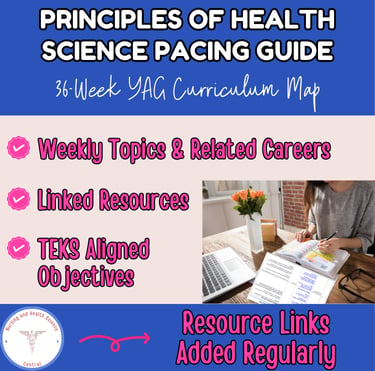
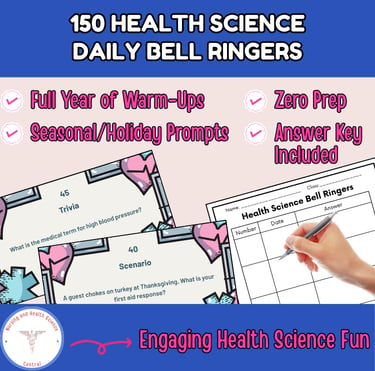
If you want a head start on your planning, the Principles of Health Science Pacing Guide gives you a complete 36-week curriculum map so you walk into August knowing exactly where your year is going. Pair it with the 150 Health Science Bell Ringers and your first five minutes of class are handled every day without any additional planning.
Want more free tools and tips for health science CTE teachers? Join our email community and get the free Back-to-School Health Science Teacher's Preparation Checklist the moment you sign up.
CONTACT Us
info@nursinghealthscience.com
© 2026. Nursing & Health Science Central. All rights reserved.