Am I in Over My Head?
What Nurses and Other Health Care Professionals Need to Know Before Teaching High School Health Science
NEW HEALTH SCIENCE TEACHER TIPS & TOOLSTIPS FOR TEACHERSBACK TO SCHOOL


You asked the question that almost every nurse or other health care professional turned health science teacher has asked at some point, usually in late July when the classroom starts to feel real.
Am I in over my head?
Here's the honest answer. Sort of. But not in the way you're afraid of.
You are not in over your head clinically. You know this content. You have lived it. You have taken vital signs on real patients in real emergencies, explained procedures to frightened people, worked as part of a team in high-stakes situations, and developed clinical judgment that took years to build. No one in your classroom will have more relevant content knowledge than you do.
You are, however, stepping into a professional role that requires a completely different set of skills than the ones that made you excellent clinically. And the health professionals who make the smoothest transitions to teaching are the ones who understand that distinction clearly from the beginning.
Here's what the transition actually looks like and how to navigate it well.
The Skills That Transfer Directly
More of your clinical skills translate to the classroom than you might expect.
Patient teaching is one of them. Every time you explained a diagnosis to a patient, demonstrated a self-care skill, or helped someone understand their medications, you were teaching. The content is different in a classroom but the core challenge is the same: taking complex information and making it understandable to someone who doesn't have your background.
Assessment is another. Nurses are trained to observe, to notice when something is off, to gather information and make judgments quickly. In a classroom you'll use those same skills to notice which students are confused, which ones checked out ten minutes ago, and which ones are struggling with something they haven't told you about yet.
Communication under pressure, working with difficult personalities, managing your own stress response when things aren't going as planned, prioritizing competing demands simultaneously. These are all clinical skills and they're all teaching skills too.
You're not starting from zero. You're starting from a different kind of professional foundation than most education graduates have, and in many ways it's a stronger one.
The Skills You'll Have to Build
The place where nurses and other health care professionals most commonly struggle in their first year of teaching is classroom management, not because they lack authority but because the kind of authority that works in a clinical setting doesn't automatically translate to a high school classroom.
In healthcare, authority is embedded in the structure. You are the professional. The patient is the patient. The roles are clear and the power differential is understood by everyone. In a classroom, you have to establish your authority through relationship and consistency rather than through institutional role. That's a learned skill and it takes time.
Lesson planning is another area where most first-year health science teachers with clinical backgrounds need development. Knowing the content deeply doesn't tell you how to sequence it for a learner who is encountering it for the first time, how long each component will take, how to check for understanding along the way, or how to adapt when something isn't landing.
These skills develop through practice, reflection, and feedback. The good news is that they develop faster when you're paying attention to them, which most experienced healthcare professionals are very good at doing.
What the First Year Actually Looks Like
There will be days in your first year that feel like failure and are actually just Tuesday.
A lesson you planned carefully will fall apart. A student will push back in a way that catches you completely off guard. You'll make a classroom management decision in the moment that you know immediately wasn't right. You'll stand in front of your class during a difficult topic and realize that knowing something deeply is not the same as being able to teach it clearly.
All of this is normal. All of it happens to good teachers. And all of it is more recoverable than it feels in the moment.
The standard you held yourself to in healthcare, where errors have clinical consequences and excellence is non-negotiable, is an asset in many ways. But it can also make the inevitable learning curve of a first year feel more catastrophic than it is. Teaching is a craft that develops over years, not a competency you achieve or don't achieve in a single semester.
Give yourself permission to be a beginner at teaching while being an expert at healthcare. Both things can be true at the same time.
The Advantage You Have That Most First-Year Teachers Don't
There's something your students need from a health science teacher that curriculum alone cannot provide, and it's something you have in abundance.
You can tell them what it's actually like.
Not what the textbook says it's like. Not what the simulation is supposed to approximate. What it actually feels like to draw blood from a patient who is terrified of needles. What it's like to take vital signs in a chaotic emergency room. What healthcare professionals actually talk about during their shifts, what they worry about, what they're proud of, what keeps them in the field even on the hardest days.
That kind of real-world context is what makes health science CTE different from any other class a student will take. And you're the one who can provide it. No textbook, no lesson plan, and no amount of pedagogical training gives you that. It comes from having actually done the work.
Your students are going to learn things in your classroom that they couldn't learn anywhere else. Because of who you are, not just what you know.
Are you in over your head? In some ways, temporarily. In the ways that matter most, absolutely not.
Get a Jump Start
If you want a complete pre-school checklist that covers your classroom setup, clinical site prep, lab organization, compliance requirements, and your own personal readiness, grab this free Health Science CTE Teacher Back to School Checklist. It was built specifically for health science classrooms and covers things no generic teacher checklist touches.
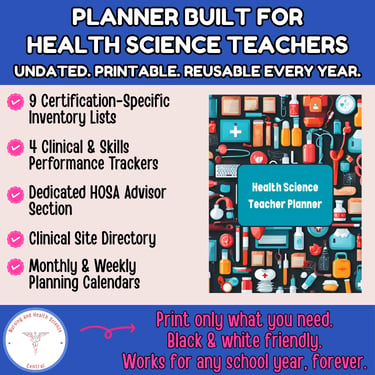
Better yet - check out our CTE Health Science Teacher Planner. It is a complete, print-and-customize planning system designed specifically for health science teachers. And it's undated - buy it once, print what you need, and use it every August for as long as you teach health science.
The our Principles of Health Science Pacing Guide and Practicum Pacing Guide for PCT, EKG, and Phlebotomy give you a complete 36-week curriculum map for each course so you don't have to build your year from scratch.