From Clinical Practice to Classroom
What Nurses and Other Healthcare Professionals Need to Know About Teaching CTE Health Science in a School Setting
TIPS FOR TEACHERSBACK TO SCHOOLNEW HEALTH SCIENCE TEACHER TIPS & TOOLS


If you've spent any time working in healthcare you've already been teaching. You just didn't do it in a classroom.
Every time you explained a diagnosis to a patient in language they could actually understand, you were teaching. Every time you demonstrated wound care to a family member who was terrified of getting it wrong at home, you were teaching. Every time you walked a new colleague through a procedure while simultaneously monitoring the patient and managing everything else happening around you, you were teaching multiple things to multiple people at the same time.
Patient and client teaching is one of the most transferable skills any healthcare professional brings to the classroom, whether you're coming from nursing, emergency medicine, medical assisting, phlebotomy, respiratory therapy, or any other clinical role. You already know how to assess what someone understands, identify the gap between where they are and where they need to be, choose an explanation that fits their level, and check whether the teaching actually landed.
That's not nothing. That's actually most of teaching.
But the classroom version of that skill set comes with its own vocabulary, its own regulatory framework, and its own set of expectations that are completely foreign to most healthcare professionals. Understanding those differences before you set foot in a classroom will save you significant confusion and a lot of time trying to decode terminology that everyone around you seems to already understand.
What's the Same: The Core Teaching Loop
In clinical patient teaching, you follow a process that probably feels automatic by now even if you've never named it formally.
You assess what the patient already knows. You identify what they need to know. You deliver the information or demonstrate the skill. You check for understanding. You reassess and reteach if necessary. You document what you taught and how it went.
That loop is also the core of classroom teaching and it maps almost exactly onto the formal lesson planning frameworks you'll encounter in a school setting. Assess prior knowledge, state learning objectives, deliver instruction, check for understanding, assess learning, reteach as needed. The vocabulary is different but the logic is identical to what you've been doing in clinical practice for years.
The main difference is scale and structure. In clinical patient teaching you're usually working with one person or a small group on a specific immediate need. In a classroom you're working with 25 to 30 people simultaneously on a planned curriculum that spans an entire school year, and your teaching has to be organized, documented, and aligned to external standards in ways that clinical teaching doesn't.
Understanding State Educational Standards
Here's one of the first pieces of educational vocabulary that will come up and it's worth understanding clearly before you need to use it.
In public secondary education, what you teach is not entirely up to you. Every course is governed by state standards, sometimes called frameworks, essential knowledge and skills, or course competencies depending on your state. These are documents published by your state's department of education or workforce agency that specify what students are expected to know and be able to do by the end of a given course.
In Texas for example, health science CTE courses are governed by the Texas Essential Knowledge and Skills, commonly called TEKS. Other states have their own equivalent documents with their own names.
As a teacher your job is to ensure that your instruction is aligned to these standards. That means every unit you teach, every assessment you give, and every skill you have students practice should trace back to a specific standard in the governing document for your course. You won't be expected to cover every standard with equal depth but you are expected to address all of them across the school year.
Think of state standards the way you think of clinical protocols or scope of practice guidelines. They're not suggestions and they're not optional. They're the established framework within which you operate, and the professional expectation is that your practice aligns with them.
When your administrators observe your classroom, when your department head reviews your curriculum, and when your program is evaluated for CTE compliance, standards alignment is one of the primary things being assessed. Getting familiar with your state's standards documents before school starts isn't optional. It's foundational.
Curriculum Terminology You'll Hear Constantly
The education world has its own vocabulary and encountering it without context can make meetings feel like they're happening in a foreign language. Here are the terms you'll hear most often and what they actually mean.
Curriculum refers to the full scope and sequence of what is taught in a course, the content, skills, and experiences students encounter across the entire school year. When someone asks about your curriculum they're asking about the big picture of what your course covers and how it's organized.
A unit is a cluster of related lessons organized around a central topic or theme. A health science course might have a unit on infection control, a unit on vital signs, a unit on medical terminology, and so on. Units typically last anywhere from one to six weeks depending on the depth of the content.
A lesson plan is a detailed written plan for a single class period or instructional sequence. It specifies what students will learn, how you'll teach it, what materials you'll use, how you'll check for understanding, and how you'll assess whether learning happened. Lesson plans vary in format by school and district but most include the same core components.
A pacing guide or year-at-a-glance is a document that maps your units across the school year, showing which topics will be covered in which weeks. It's your roadmap for the whole year and one of the most valuable planning tools you can have as a first-year teacher.
Scope and sequence refers to the breadth of content covered in a course, the scope, and the order in which it's taught, the sequence. Thinking about scope and sequence is what you do when you decide not just what to teach but what to teach first, what to build on next, and what can only be taught after something else is in place.
Formative assessment is any check for understanding that happens during the learning process rather than at the end. Bell ringers, exit tickets, quick quizzes, thumbs up or down, cold-call questions, and skills observations during practice are all formative assessments. They tell you whether students are getting it while there's still time to adjust your teaching. Your administrators will be looking for evidence that you monitor and adjust when they visit your classroom.
Summative assessment is the evaluation that happens at the end of a unit or course to determine what students learned. Tests, projects, skills check-offs, and final exams are summative assessments. They tell you whether learning happened but they can't change what's already been taught.
Differentiation refers to adapting your instruction to meet the varying needs, readiness levels, and learning styles of students in your classroom. A differentiated lesson doesn't mean you teach different content to different students. It means you might provide the same content in multiple formats, offer different levels of support for completing the same task, or give students multiple ways to demonstrate what they've learned.
An IEP, or Individualized Education Program, is a legally binding document that specifies the educational accommodations and services required for a student with a disability. As a classroom teacher you are legally required to implement the accommodations specified in any student's IEP. This is not optional and it's not at your discretion. If a student's IEP says they receive extended time on tests, they receive extended time on tests. If it says they're allowed to take assessments in a separate quiet space, that happens. Your special education department or case manager can explain the specific IEPs in your class and what they require of you.
A 504 plan is similar to an IEP but applies to students whose disabilities affect their learning without requiring special education services. Accommodations under a 504 might include preferential seating, extended time, or reduced distraction environments. Same principle applies. These accommodations are not optional.
Writing Learning Objectives: The Clinical Version
In clinical settings you're already familiar with patient-centered goals. By discharge, the patient will be able to demonstrate correct insulin injection technique. By the end of this teaching session, the patient will identify three signs of infection that warrant calling the provider.
Learning objectives in education work exactly the same way. They're statements that describe what students will be able to do by the end of a lesson or unit, written from the student's perspective and measurable enough that you can actually assess whether they happened.
A well-written learning objective has three components. An observable action verb that describes what students will do (check out Bloom's taxonomy verbs). The specific content or skill the verb applies to. And the level of performance that constitutes success. Districts may have a specific format they require for writing learning objectives. Learning objectives may begin with the phrase, "students will be able to." They may also be written in multiple parts that identify what will be done together in class, the purpose, what will be done independently, and how students will know they've got it.
Observable action verbs are critical and this is where clinicians actually have an advantage over many education graduates. You already know the difference between understanding something and being able to do something. That distinction lives in your verb choice.
Identify, demonstrate, calculate, explain, compare, perform, apply, and analyze are all observable verbs that describe things you can actually watch a student do. Know, understand, appreciate, and learn are not observable because you can't directly observe knowing or understanding. You can only observe what someone does with what they know.
A learning objective that says "students will understand vital signs" is not a useful objective because you can't assess understanding directly. A learning objective that says "students will correctly measure and document adult blood pressure using a manual sphygmomanometer" is useful because you can watch a student do exactly that and determine whether they did it correctly.
Write your objectives before you plan your lessons, not after. Your objectives tell you what students need to be able to do by the end. Your lessons are how you help them get there. If you write your lessons first you'll often end up teaching without a clear target and assessing without a clear standard.
Lesson Planning: What It Actually Looks Like
A lesson plan is a blueprint, not a script. Its purpose is to ensure you've thought through the instructional sequence before you're standing in front of students, not to dictate exactly what you'll say word for word.
Most lesson plan formats include the following components. The learning objective or objectives for the lesson. The materials and resources needed. A brief warm-up or activating activity to connect to prior knowledge, your bell ringer fits here. The main instructional activity or activities. A check for understanding during and/or at the end of the lesson. A brief closure activity that helps students consolidate what they learned. And any homework or follow-up assignment.
In your first year, writing detailed lesson plans is worth the time even when it feels tedious. The process of planning forces you to think through potential problems before they happen. You'll discover mid-plan that an activity you intended for 20 minutes will actually take 40, or that students will need a concept explained before they can engage with the main activity, or that you don't actually have the materials you planned to use.
As you get more experienced you'll write less formal plans because more of the planning happens automatically. But in year one, the discipline of writing it out protects you from walking into class underprepared.
Differentiation: You're Already Doing It
Differentiation is one of those education terms that sounds more complicated than it is, and healthcare professionals are often already doing a version of it without recognizing it.
In clinical patient teaching you naturally adjust your language for a patient who has a medical background versus one who has never encountered healthcare before. You give more support to a patient who is scared and overwhelmed than one who is calm and engaged. You check for understanding more frequently with a patient who seems confused. You use different explanations for a visual learner than for someone who learns better by doing.
All of that is differentiation. Adjusting your instruction based on the needs of the individual learner.
In a classroom you're doing this for 25 to 30 people simultaneously which is the part that's genuinely harder. But the underlying skill, reading your learner and adapting accordingly, is something you've been developing throughout your clinical career regardless of which role you came from.
Practical differentiation strategies that work well in health science CTE classrooms include providing reference charts and visual aids so students who process visually aren't dependent on auditory instruction alone. Offering written step-by-step instructions alongside live demonstration during skills labs so students can refer back to the steps independently. Allowing students to demonstrate skills in partners before demonstrating individually so anxious students have a lower-stakes first attempt. Providing sentence starters or graphic organizers for students who struggle with open-ended writing tasks. And giving advanced students extension questions or additional complexity rather than just more of the same work.
You don't have to differentiate everything for every student every day. You need to be aware that your students have different starting points, different processing speeds, different learning strengths, and different support needs, and make choices that account for that reality across your instruction over time.
Other Terms and Expectations Worth Knowing
A few more things that will come up and that most first-year teachers from clinical backgrounds don't know going in.
Duty of care is a legal and professional obligation you have as a teacher to take reasonable steps to protect students from foreseeable harm. In a health science classroom this has specific implications for your skills lab, your clinical site preparation, and your supervision of student practice. You cannot leave students unsupervised with clinical equipment. You are responsible for ensuring the environment is safe before students enter it.
Mandatory reporting means that as a teacher, just as a healthcare professional, you are a mandated reporter, legally required to report suspected child abuse or neglect to the appropriate authorities. This is non-negotiable and the threshold for reporting is suspicion, not proof. Your school may also have a specific protocol for how to report and who to notify within the building. Know it before you need it.
Professional learning community, or PLC, refers to collaborative groups of teachers who meet regularly to review student data, align instruction, and improve professional practice. As a new teacher you'll likely be assigned to one. Think of it like a clinical team meeting, people with shared goals working through challenges together.
Vertical alignment refers to the coherence of curriculum across grade levels so that what students learn in one course builds logically on what they learned in a previous one and prepares them for what comes next. Understanding vertical alignment helps you know what prior knowledge students are supposed to bring into your class and what they'll need from your course as a foundation for future ones.
And finally, a lesson observation or walkthrough is when an administrator visits your classroom, sometimes announced and sometimes not, to observe your teaching. First-year teachers often find these anxiety-inducing. The most useful mindset shift is to see observers not as evaluators looking for problems but as people who want to see students learning. If your students are engaged, on task, and doing something academically meaningful, an observation will go fine regardless of whether your lesson plan format is perfect. Use the feedback you receive to improve your skills and your students' learning. Don't be afraid to ask your appraiser for clarification and suggestions.
The Advantage You Have That Most First-Year Teachers Don't
There's something your students need from a health science teacher that curriculum alone cannot provide, and it's something every experienced clinician has in abundance regardless of their specific role.
You can tell them what it's actually like.
Not what the textbook says it's like. Not what the simulation is supposed to approximate. What it actually feels like to be in a real clinical setting with a real patient, a real team, and real stakes. What healthcare professionals actually talk about during their shifts. What they worry about, what they're proud of, what keeps them in the field even on the hardest days.
That kind of real-world context is what makes health science CTE different from any other class a student will take in high school. And it doesn't matter whether your background is emergency medicine, medical assisting, phlebotomy, or any other clinical role. Your specific experience from your specific field is exactly what your students need to hear, because there are students in your classroom right now who are going to go into that same field and need someone who has actually been there to tell them what it's really like.
No textbook, no lesson plan, and no amount of pedagogical training gives you that. It comes from having actually done the work.
You've been teaching throughout your clinical career. The classroom version of that skill is learnable, the vocabulary is acquirable, and the things you don't know yet are things you can find out.
The transition from clinical practice to the classroom is one of the most meaningful professional pivots a healthcare professional can make. Your students are going to learn things from you that they couldn't learn from anyone else. That's worth whatever learning curve comes with it.
Need a Little Help Getting Started?
No worries - we've got you!
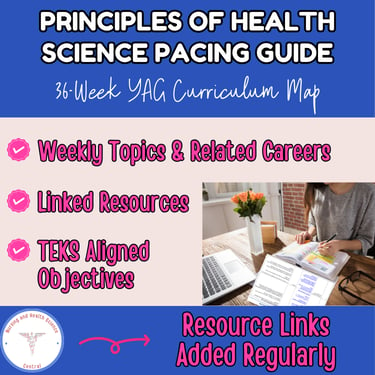
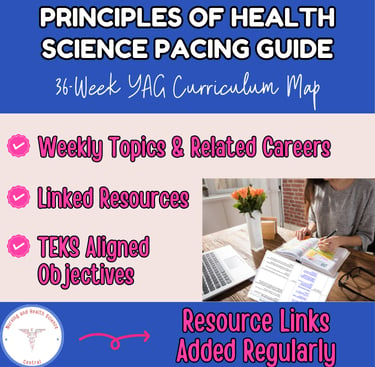
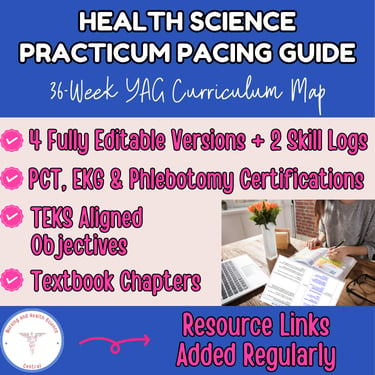
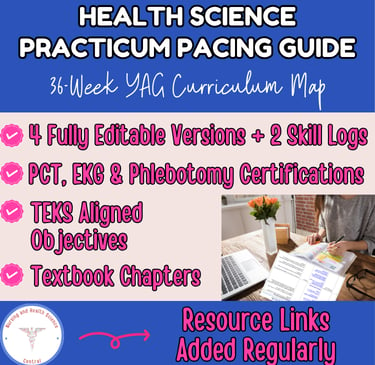
If you want a complete 36-week curriculum map already built for you, our Principles of Health Science Pacing Guide and Practicum Pacing Guide for PCT, EKG, and Phlebotomy give you a ready-made framework so you're not building your year from scratch.
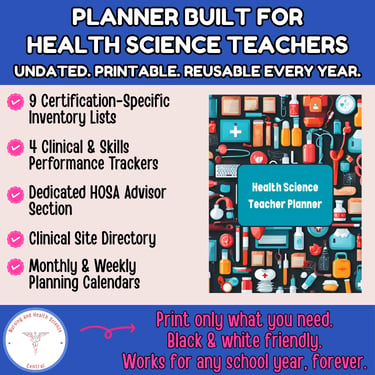
Also check out our CTE Health Science Teacher Planner. It is a complete, print-and-customize planning system designed specifically for health science teachers. And it's undated - buy it once, print what you need, and use it every August for as long as you teach health science.
Want more free tools and tips for health science CTE teachers? Join our email community and get the free Back-to-School Health Science Teacher's Preparation Checklist the moment you sign up.