What to Do This Summer If You're Teaching Health Science for the First Time This Year
Tips for new high school CTE teachers.
NEW HEALTH SCIENCE TEACHER TIPS & TOOLSTIPS FOR TEACHERSBACK TO SCHOOL


If you've just been hired to teach CTE health science for the first time and you're spending your summer somewhere between excited and terrified, that's exactly where you should be. The excitement means you care about doing this well. The terror means you understand that it's a real job with real stakes.
The summer before your first year of teaching is one of the most valuable preparation windows you'll ever have because you have time now that you absolutely will not have in October. Use it well and you'll walk into August feeling ready. Skip it and you'll spend your first semester perpetually behind.
Here's what's actually worth doing this summer.
Get Into Your Classroom If You Can
If your school will give you access to your classroom before the year starts, go. Not necessarily to set anything up, just to stand in the room and see it.
Where are the electrical outlets relative to where you'll want equipment? Is there a sink? Where is the storage? How does the lighting affect where students will be able to see demonstrations? Where will you stand when you're teaching? Where will the clinical practice area be relative to the seated learning area?
These questions don't have answers until you're actually in the room, and answering them in July means you're not answering them at 6am on the first day of school.
If your room is a dedicated health science lab, take inventory of what equipment is there. You'll need to know what you have before you can figure out what you need to request, borrow, or buy.
Learn Your Curriculum Standards Before You Plan Anything
Before you build a single lesson or buy a single resource, know what you're required to teach. This means looking up your state's standards for the specific course you've been hired to teach, whether that's Principles of Health Science, a practicum course, a certification-specific course, or something else.
Standards documents tell you what students are supposed to know and be able to do by the end of the course. Everything you plan should trace back to those standards. And if you plan without reading them first, you'll inevitably spend time on things that aren't required and miss things that are.
This step takes a few hours and saves you many more hours of replanning later.
Map Your Year Before You Plan Your Units
Once you know your standards, create a rough year-at-a-glance map before you start planning individual lessons. What are the major units or topic areas you'll cover? How many weeks does each one need? In what sequence do they build on each other? When does each grading period end and what holidays does your district observe?
This doesn't have to be detailed. A one-page calendar with unit names and approximate timeframes is enough. The point is to see the whole year before you start planning any part of it so you don't spend ten weeks on content that should take six and then scramble through everything that comes after.
Learn Your Clinical Partners If You Have Them
If your program includes clinical rotations, spend part of your summer researching before school starts, preparing to establish those relationships. Look up every clinical site you'll be using, become familiar with the location, the layout, and key contacts. Plan a date to reach out and schedule a meeting with your site coordinator.
Clinical partners are one of the most valuable assets a health science CTE program has and the relationship between the teacher and the site coordinator determines a lot about how well placements go for students. Preparing for that relationship in July rather than September gives you a real advantage.
Connect With Other Health Science Teachers
The health science CTE teacher community is more connected than you might expect. There are Facebook groups, online communities, and professional organizations specifically for health science CTE educators where teachers share resources, ask questions, and support each other through exactly the challenges you're about to face.
Join those communities this summer. Ask questions before you need the answers urgently. Read through past discussions about classroom management, clinical site logistics, certification prep, and all the other topics that are going to come up in your first year. You will almost certainly find that someone has already worked through every problem you're going to encounter and is willing to share what they learned.
Build a Resource Library Before School Starts
You are not going to have time to build lessons from scratch during the school year. Teachers who try to plan everything week by week while also teaching, grading, managing clinical logistics, and handling everything else the job involves end up burning out by November.
Use your summer to build or collect a library of resources you can draw from throughout the year. This doesn't mean planning every lesson now. It means having quality materials available so when you need an activity for a specific topic, you're not starting from nothing at 10pm the night before.
Take Care of Yourself Too
This one sounds obvious and gets ignored constantly. Teaching is hard even when you know what you're doing, and your first year will be harder than the ones that follow. That's not a reason to be discouraged. It's a reason to walk in rested.
Don't spend your entire summer in teacher mode. Do the things that fill you back up. Spend time with people you care about. Sleep. Move your body. Read things that have nothing to do with health science or education.
The most prepared version of yourself for August is the one that is both organized and rested. You can be both.
The summer before your first year of teaching is a gift. Use it deliberately and you'll walk into August with a foundation underneath you that takes some teachers years to build.
Get a Head Start
If you want a complete pre-school checklist that covers your classroom setup, clinical site prep, lab organization, compliance requirements, and your own personal readiness, grab the free Health Science CTE Teacher Back to School Checklist. It was built specifically for health science classrooms and covers things no generic teacher checklist touches.
Better yet - check out our CTE Health Science Teacher Planner. It is a complete, print-and-customize planning system designed specifically for health science teachers. And it's undated - buy it once, print what you need, and use it every August for as long as you teach health science.
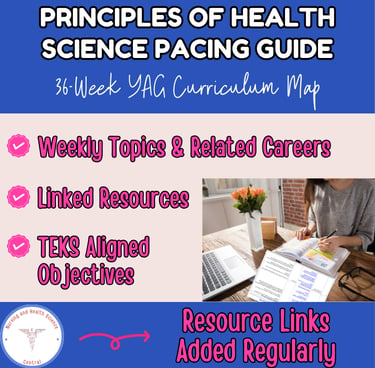
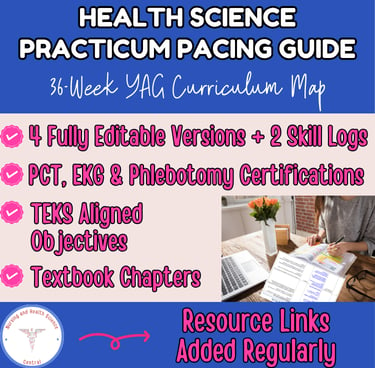
The our Principles of Health Science Pacing Guide and Practicum Pacing Guide for PCT, EKG, and Phlebotomy give you a complete 36-week curriculum map for each course so you don't have to build your year from scratch.