How to Plan Your CTE Health Science Year Without Burning Out by October
How to Plan Your CTE Health Science Year Without Burning Out
NEW HEALTH SCIENCE TEACHERSTIPS FOR TEACHERSBACK TO SCHOOL


Let's be real about something.
The teachers who burn out by October didn't run out of passion. They ran out of plan. They started the year doing everything from scratch, building lessons on Sunday nights, scrambling to figure out what to teach next week while also grading what they taught last week, and gradually falling behind until the gap between where they were supposed to be and where they actually were became too big to close.
It doesn't have to go that way. And for health science teachers specifically, there's a smarter way to approach the year that protects your time, keeps students on track for certification, and lets you actually enjoy teaching instead of just surviving it.
Here's how to plan a full year of health science without ending up face down on your desk by Columbus Day.
Start With the End in Mind
Before you plan a single lesson, know what your students need to accomplish by the end of the year. For most health science programs that means certification readiness. Whether you're teaching PCT, EKG, Phlebotomy, CNA, CCMA, or Pharm Tech, there's a body of knowledge and a set of skills your students need to demonstrate before they can sit for an exam or walk into a clinical setting with confidence.
Get that list in front of you before you do anything else. If your program has specific state standards like TEKS that govern what you teach, pull those too. Your entire year flows backward from those endpoints.
Once you know where you're going, you can figure out how to get there. And that's a much more manageable problem than starting with week one and hoping it all works out by May.
Break the Year Into Units, Not Lessons
One of the most common planning mistakes health science teachers make is trying to build out their year lesson by lesson before school even starts. That's an enormous amount of work and it's almost guaranteed to become outdated the moment something changes, which in a health science classroom happens constantly.
Instead, plan at the unit level first. What are the major topics or skill clusters you'll cover this year? How many weeks does each one need? In what order do they build on each other?
For a Principles of Health Science course a typical unit structure might look like history and careers of healthcare, communication and professionalism, infection control and safety, body systems and medical terminology, legal and ethical issues, and health promotion and disease prevention. That's six major units across a 36-week school year, which gives you roughly six weeks per unit with some buffer built in.
For a practicum course like PCT or Phlebotomy the structure follows the certification blueprint. You're covering whatever the national exam covers, in an order that builds from foundational knowledge to hands-on skill application.
Map those units onto a calendar and you have a year at a glance. That's your plan. Everything else is details you can fill in as you go.
Build In Buffer From the Start
This is the planning advice health science teachers almost never follow and almost always wish they had.
Build empty weeks into your plan from the beginning. Not weeks where you'll figure something out later. Actual intentional buffer time for the things that will inevitably disrupt your schedule.
Clinical site days that run long. Skills check-offs that take twice as long as expected because half the class needs extra practice. A student who didn't get their background check cleared in time and needs an alternative assignment. A fire drill that eats 20 minutes of your most carefully planned skills lab. A week of state testing that pulls half your class out of rotation.
These things happen in every health science program every single year. Teachers who planned for them stay on track. Teachers who didn't plan for them spend the rest of the semester scrambling.
A good rule of thumb is to plan for 30 instructional weeks in a 36-week school year. That gives you six weeks of buffer spread across the year for all the things you can't predict. It sounds like a lot until October when you've already used three of them and you're grateful every single time.
Align Your Pacing to Certification Timelines
If your students are sitting for a certification exam, work backward from the test date to figure out when content needs to be covered.
Most national certification exams for programs like PCT, Phlebotomy, CNA, and CCMA have registration deadlines and testing windows that fall in spring. That means students need to have covered all the content and completed their required clinical hours before that window opens. Which means you need to be wrapping up new instruction and moving into review the beginning of the spring semester.
Backwards mapping looks like this. Your district wants certification exams completed by the end of April. Students need three weeks of dedicated exam review before that. New content needs to be done by early March. Which means your instructional units need to be sequenced to finish in February. Which tells you exactly how many weeks you have per unit from August to February and where you need to be at each point along the way.
When you see it laid out that way, the whole year makes sense. And more importantly, you can tell by October whether you're on pace or whether you need to adjust.
Differentiate Between Must-Cover and Nice-to-Cover
In a perfect world you'd cover everything. In the real world, something always gets cut. The teachers who plan well decide in advance what gets cut when time runs short instead of making that decision in a panic in April.
Go through your content and label each unit or topic as either essential or enrichment. Essential content is anything directly tied to certification standards, clinical competency, or state requirements. Enrichment content is everything else that adds value but isn't strictly required.
When you're on pace, you teach everything. When you're behind, you protect the essential content and shorten or skip the enrichment content. That decision is a lot easier to make calmly in July than desperately in March.
Don't Build Everything From Scratch
This is the part where a lot of health science teachers are leaving enormous amounts of time and energy on the table.
You don't have to build every lesson, every assessment, every activity, and every pacing guide from nothing. Other teachers have already done this work. Resources exist. Using them isn't cutting corners, it's being smart about where you spend your limited planning time. This is especially true if this is your first year teaching.
The hours you save by starting with a solid ready-made pacing guide instead of building one from scratch are hours you can spend on the parts of teaching that actually require your specific expertise, like adjusting content for your specific students, building relationships with your clinical partners, and actually being present in your classroom instead of buried in planning.
A well-planned year doesn't mean everything will go perfectly. It means when things go sideways, which they will, you have enough structure underneath you that you can adapt without losing your footing.
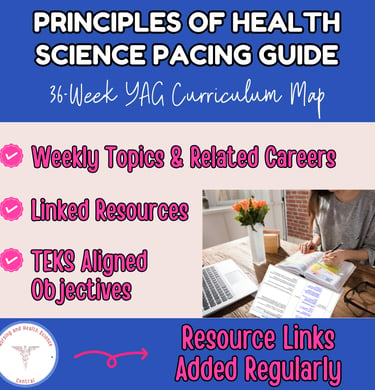
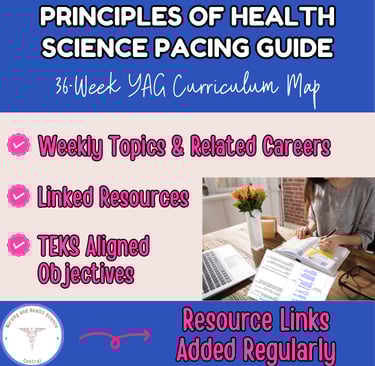
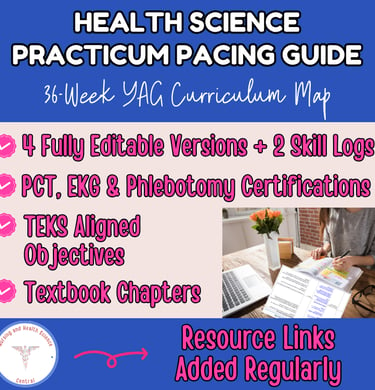
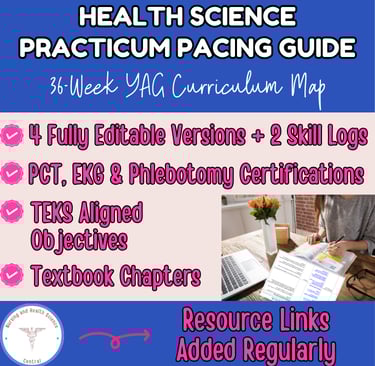
If you want a complete 36-week framework already built for you, our Principles of Health Science Pacing Guide maps out your entire year week by week with topics, suggested activities, and alignment to standards. The Health Science Practicum Pacing Guide does the same for PCT, EKG, and Phlebotomy certification courses - this one is editable so you can make it your own without starting from scratch.
For a comprehensive start, check out our CTE Health Science Teacher Planner. It is a complete, print-and-customize planning system designed specifically for health science teachers. And it's undated - buy it once, print what you need, and use it every August for as long as you teach health science.
Want more free tools and tips for health science CTE teachers? Join our email community and get the free Back-to-School Health Science Teacher's Preparation Checklist the moment you sign up.


CONTACT Us
info@nursinghealthscience.com
© 2026. Nursing & Health Science Central. All rights reserved.